Easton, Bristol
The Shah Jalal Jame Mosque Extension is a community-led project responding to the growing need for increased prayer capacity, clearer spatial organisation, and a contemporary Islamic presence within Easton, Bristol.
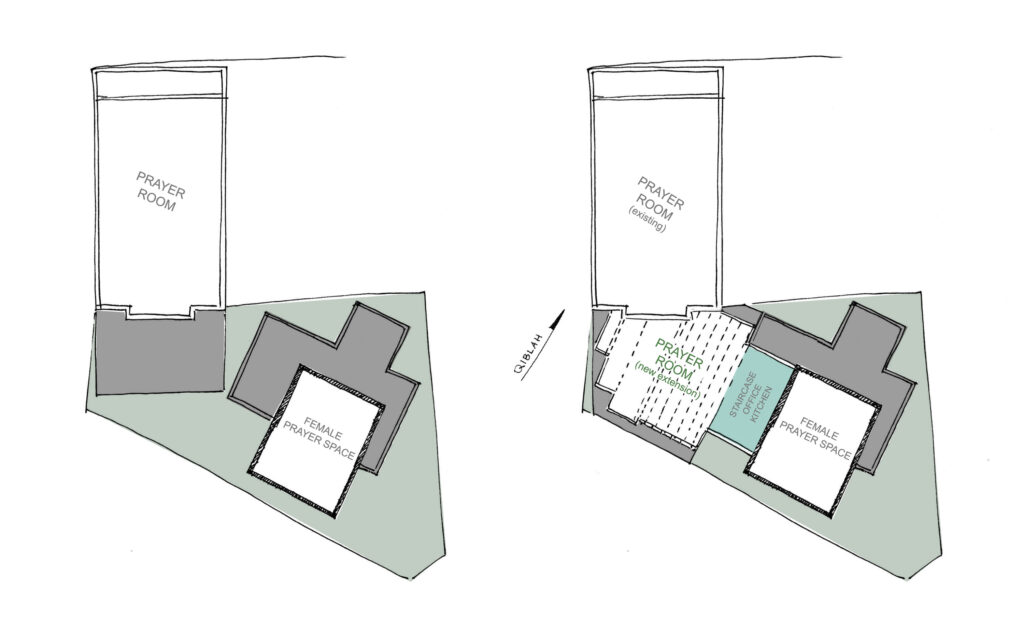
Over time, the mosque had evolved incrementally. Prayer spaces, entrances, and circulation were added as needs arose, resulting in a fragmented internal layout and an unclear public presence. The proposal addresses this condition not through replacement, but by careful re-ordering of the existing building and expansion, to restore clarity and coherence.
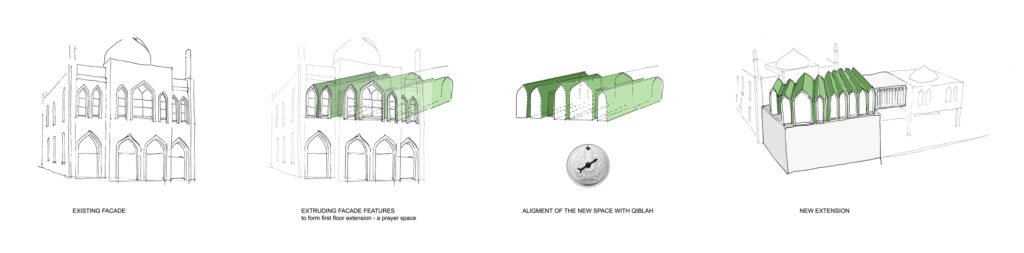
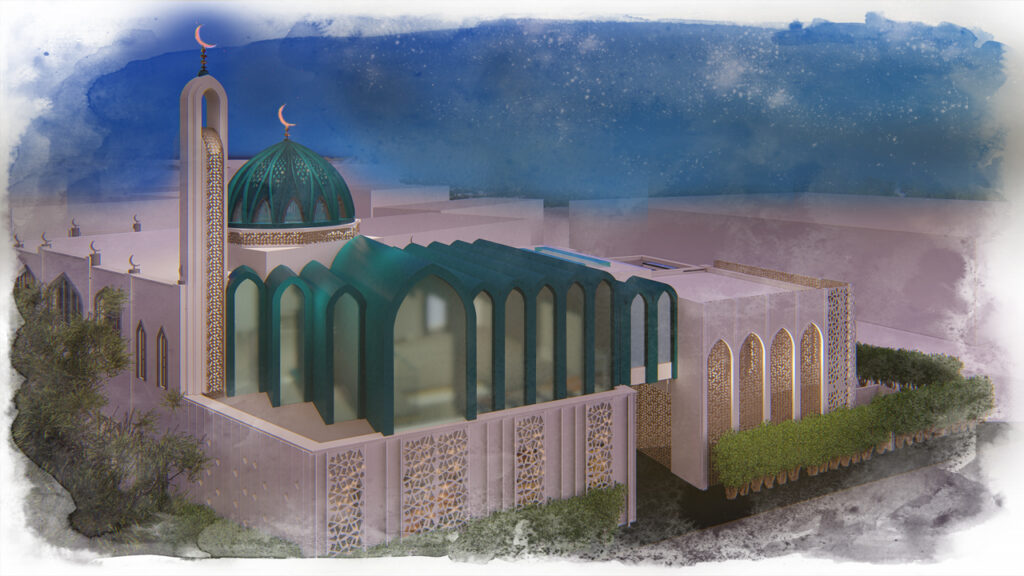
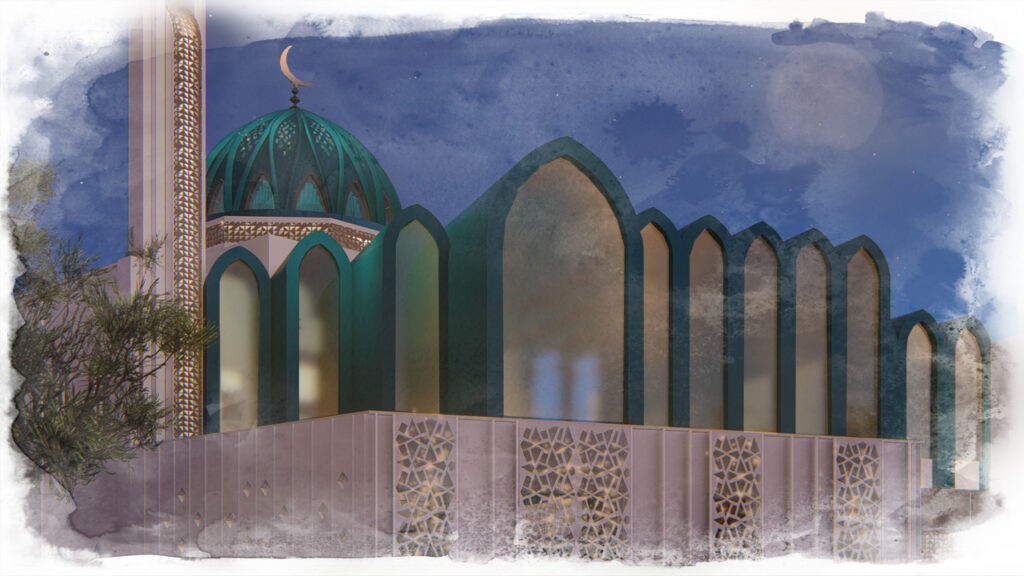
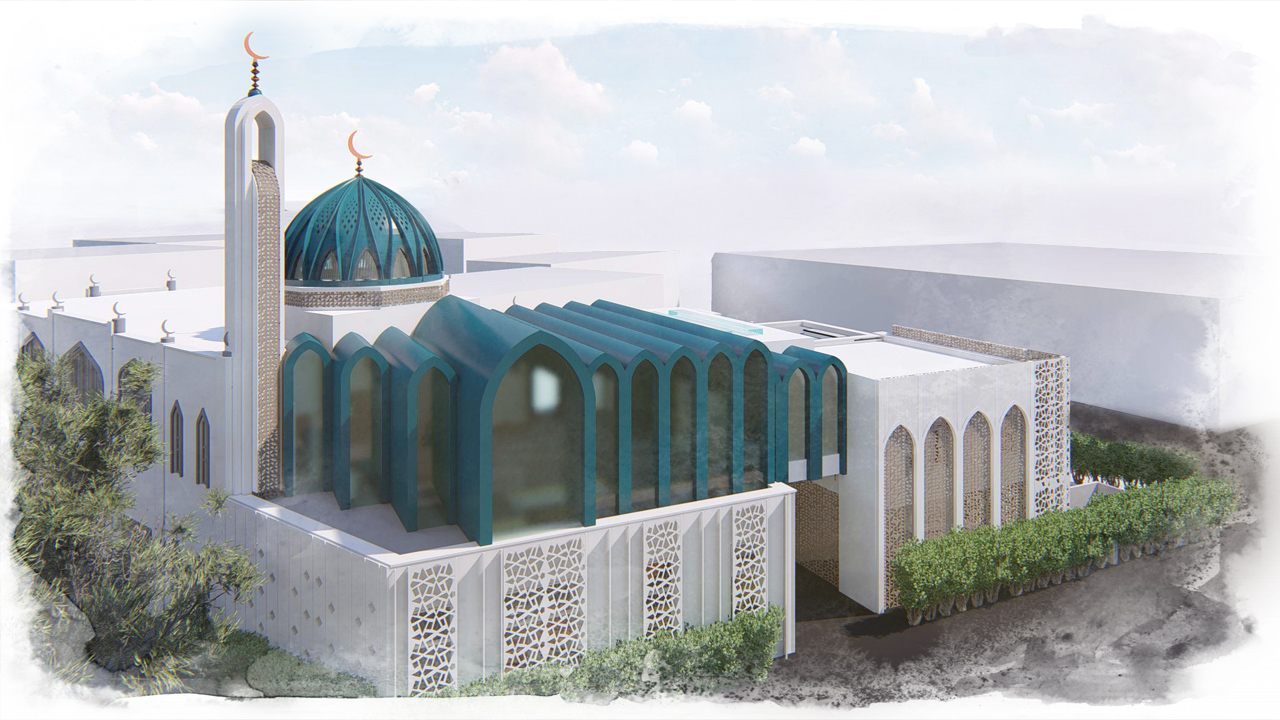
A new double-storey extension, precisely aligned to the Qibla at first-floor level, increases prayer capacity while remaining architecturally restrained. Rather than introducing a competing form, the extension establishes a new directional order, re-orienting both new and existing prayer spaces into a single, legible whole. The mosque’s existing arch language is reinterpreted as a rhythmic architectural envelope—experienced both externally and within the interior—extending the identity of the building without formal excess.
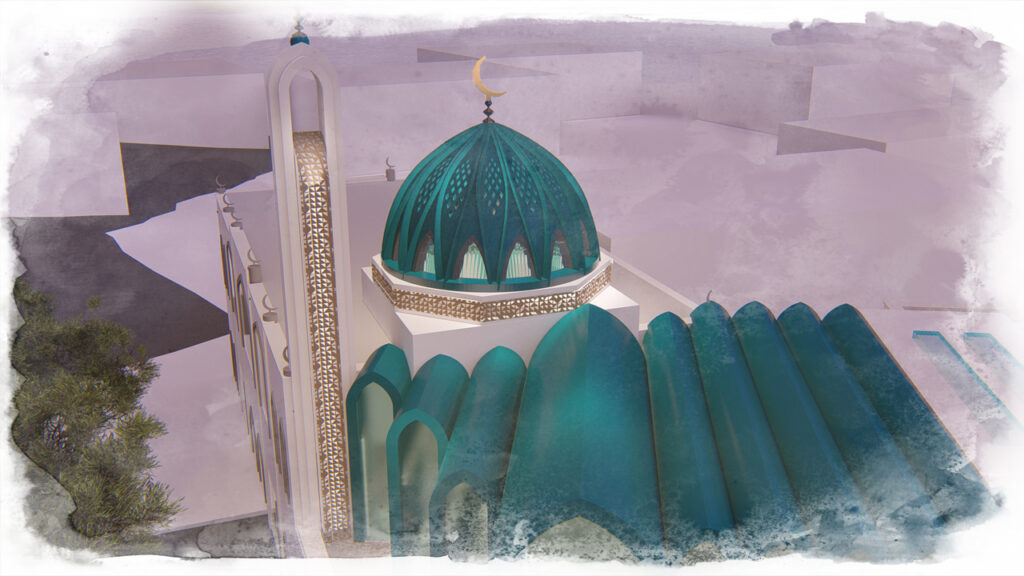
The project is highly visible from the M32 overbridge, a key point of arrival into Bristol. This condition is treated as part of the mosque’s immediate context. The introduction of a new minaret and a reconfigured dome replaces the former, modest elements with a contemporary interpretation of traditional Islamic architecture. Together, these elements establish a recognisable civic presence—signalling the mosque as a spiritual and cultural landmark along the highway approach to the city.
A new double-storey extension, precisely aligned to the Qibla at first-floor level, increases prayer capacity while remaining architecturally restrained. Rather than introducing a competing form, the extension establishes a new directional order, re-orienting both new and existing prayer spaces into a single, legible whole. The mosque’s existing arch language is reinterpreted as a rhythmic architectural envelope—experienced both externally and within the interior—extending the identity of the building without formal excess.
Spatial clarity is central to the design. A legible sequence is established: a clear point of arrival, a disciplined transition through the clean-zone threshold, and prayer spaces reconnected both spatially and symbolically. This reorganisation restores order while retaining the character and memory of the original building.
Internally, a new vertical opening reconnects previously separated prayer levels, allowing the dome to be experienced as part of a single spatial narrative. This intervention restores visual and symbolic continuity, strengthening orientation, collective presence, and the experience of congregational prayer.
Supporting facilities are comprehensively upgraded. New, spacious ablution areas are designed to accommodate increased capacity, with a clearly defined staircase leading to the upper prayer level. The internal layout is carefully organised to separate clean and dirty zones, while improving the functionality and size of key communal spaces, including the main office and communal kitchen.
The Khadiza Centre, housing the ladies’ prayer spaces, has been thoughtfully reconsidered within the largely existing structure. A significant internal reconfiguration improves comfort, accessibility, and practicality—introducing increased prayer capacity, dedicated pram parking at the entrance, a communal area, and direct access to the main kitchen. These changes ensure the women’s spaces are integrated as an essential and equal part of the wider Islamic centre.
The project demonstrates how incremental, community-built religious architecture can be re-ordered rather than replaced—achieving clarity, capacity, and civic presence through careful spatial judgement, restraint, and respect for context.